
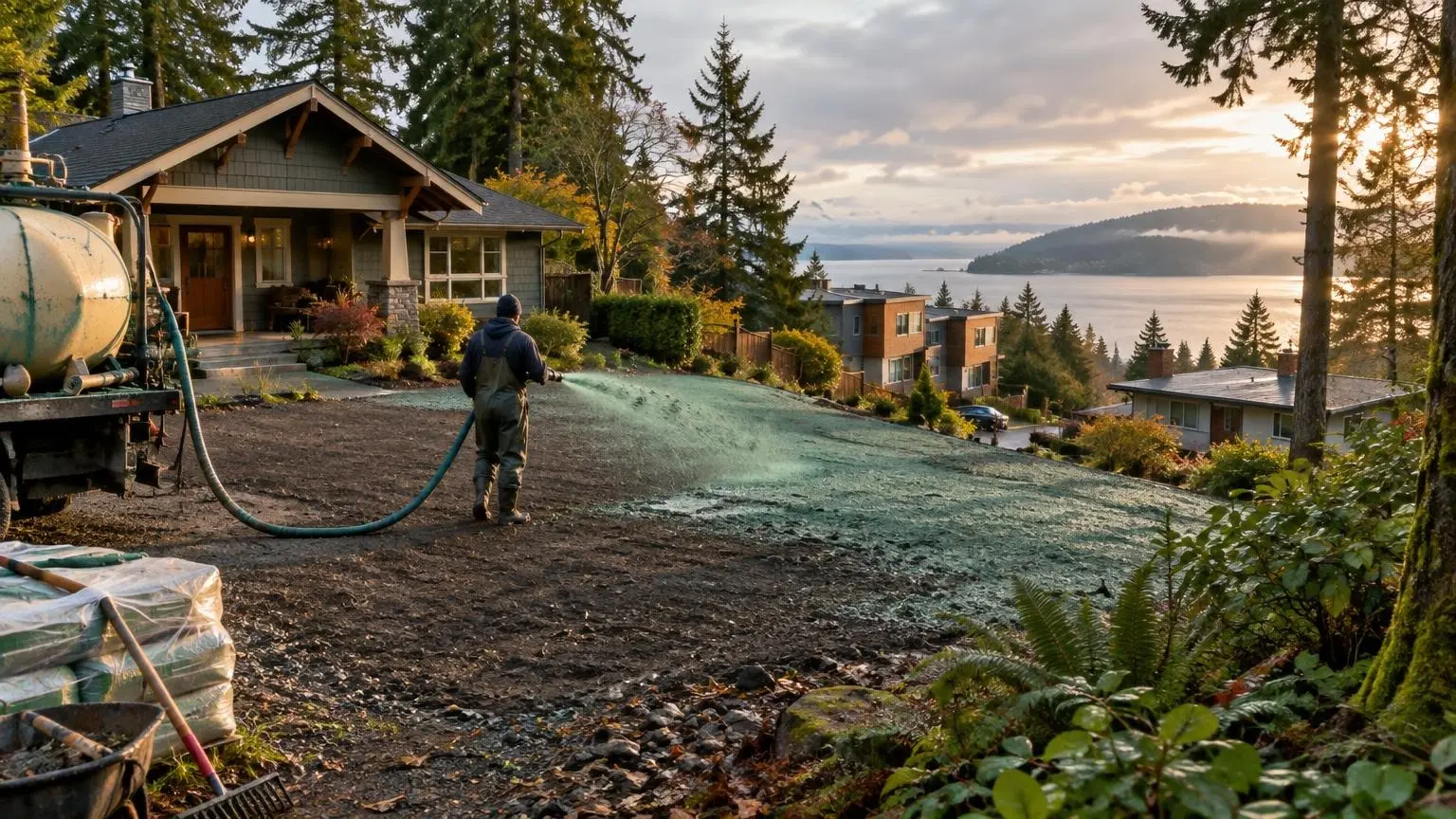
Seed that holds through a Puget Sound winter
Hydroseeding in Seattle, WA
New lawns, bare slopes and builder lots sprayed with seed, mulch and tackifier, timed around the rain.
- We walk your property first, then put the quote in writing at no charge
- Seeding dates planned around Seattle's dry summer and wet winter
- One crew for grading, seeding and sediment control
Why Seattle Ground Needs a Plan Before the Seed
Hydroseeding in Seattle is a good fit for the way the city is built: small, sloping lots, lots of new construction, and a climate that alternates between months of steady drizzle and a summer with almost no rain at all. In the tank we blend water with grass seed, a wood or paper fiber mulch, fertilizer and a tackifier, then spray that slurry over soil we have already prepared. The fiber keeps the seed from drying out, and the tackifier binds the layer to the dirt, which is why it stays on a bank where loose seed would slide downhill in the first hard shower. Our hydroseeding services cover new lawns and construction sites, along with the erosion control, silt fence and grading work that goes around them.
Rain that arrives on a schedule
Sea-Tac's 1991 to 2020 normals record measurable precipitation on about 156 days a year, and most of it falls between October and March. November alone averages 6.31 inches. The warm stretch is the reverse: September averages 1.61 inches and the weeks before it are drier still. For a homeowner, that means two practical seeding windows. Early fall, after the heat breaks and the first rains come back, lets the soil stay warm enough for germination while the sky does most of the watering. Spring works once the soil warms, but a lawn sown in May has to be watered by hand or by sprinkler through a nearly dry summer. We will seed in either window. We just want you to know which one asks more of your hose.
Glacial soil with a hard floor
Much of the upland ground around Puget Sound was shaped by glaciers, and it shows in the soil. The USDA describes the Alderwood series, an extensive upland soil in western Washington, as gravelly sandy loam over dense glacial till, with that dense layer starting 50 to 100 centimeters down. Water moves easily through the top but very slowly through the till, so from December through April a perched water table can sit 30 to 90 centimeters below the surface. In a yard, that looks like soggy low spots in winter and thin, droughty turf in August, because the roots have only a shallow layer to work in. Before we seed, we check how deep the loose soil goes and recommend added topsoil where it is thin.
Hydroseed, sod or dry seed
Each has a place. Sod gives an instant lawn and suits a small, flat yard that needs to look finished this week, but it costs the most and a roll laid on a slope or in summer heat needs careful watering to root. Dry grass seeding by hand or spreader is the cheapest and fine for patching, yet birds, wind and rain move it around, and the University of Nebraska Extension notes it can take two to three weeks to show, against five to seven days for hydroseed. Hydroseeding sits between them on cost, and it handles odd shapes, banks and large open areas well. On most Seattle-area lots with any grade at all, it is the option we recommend.
Grass that suits a cool, cloudy climate
Seattle's Mediterranean-type climate, warm and dry in summer and cool and wet in winter, calls for cool-season grasses. Washington State University Extension's guidance for western Washington lawns is a mix of roughly 90 percent turf-type tall fescue and turf-type perennial ryegrass: the ryegrass takes full sun and traffic, and the tall fescue handles shadier spots. Fine-leaved and chewings fescues also establish well and take some shade, but not heavy use. WSU advises against mixes heavy in Kentucky bluegrass, and warm-season grasses such as bermuda and zoysia do not belong here at all. We pick the blend after seeing the site. A backyard under western redcedar and Douglas-fir needs more shade tolerance than an open south-facing front yard, and a play area needs more wear tolerance than a parking strip.
Slopes, runoff and mud on the sidewalk
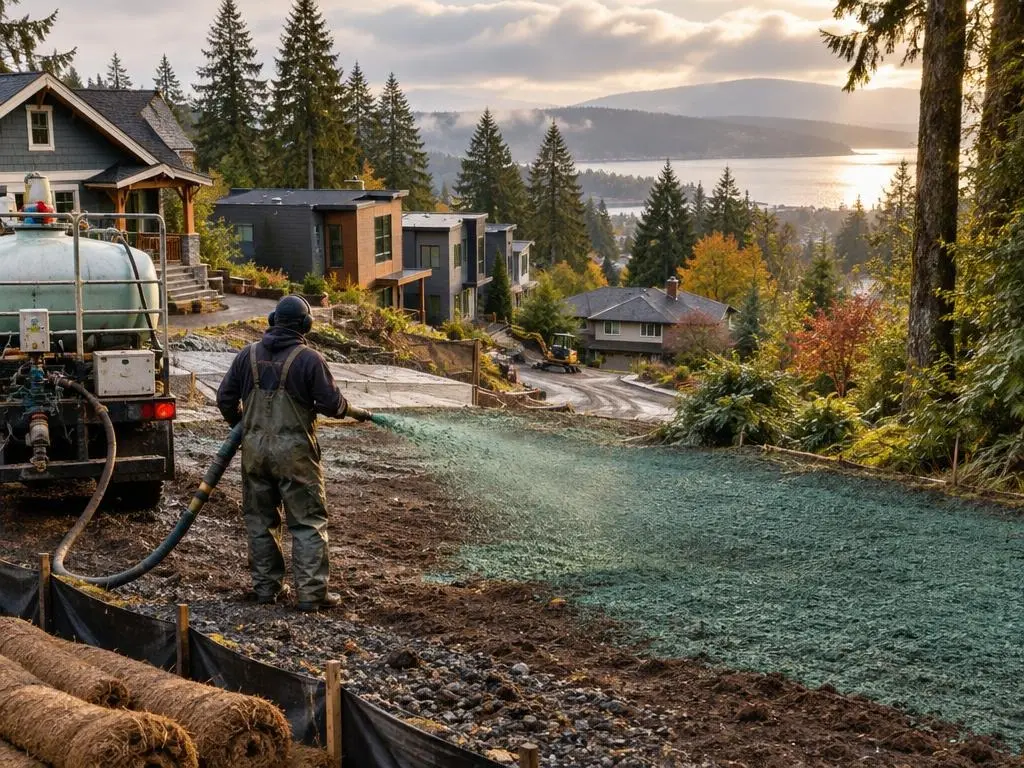
The city is hilly in places, with its highest point at 520 feet in West Seattle, and many lots tilt toward a street, alley or ravine. When a remodel strips a slope bare, the winter rain carries soil onto sidewalks and into catch basins. On those jobs we often combine seeding with erosion control blankets, a thicker application of hydromulch or bonded fiber matrix, plus silt fence along the low edge and inlet protection at nearby drains. The City of Seattle's Stormwater Code and Manual include a full volume on construction stormwater control, and a building or grading permit triggers stormwater review when a project disturbs more than 5,000 square feet of land, among other thresholds. Smaller projects can use the city's standard construction stormwater control and soil management plan. If your plans list specific sediment controls, send them along and we will price exactly what they call for.
A city that keeps building
Seattle grew 21.1 percent between 2010 and 2020, to 737,015 residents, and much of that growth came as infill: townhomes on old single-family lots, backyard cottages and additions. Each of those projects ends with bare, compacted dirt around the new foundation. That is where we come in, often in the same visit: fine grade, spread topsoil, set any required silt fence, then spray seed. When the grading, sediment control and seeding come from one hydroseeding company, the soil never sits exposed waiting for the next trade to show up.
Shade, moss and big conifers
Many Seattle-area yards are edged by tall Douglas-fir, western hemlock and western redcedar, the same trees the USDA lists as native vegetation on Alderwood soils. They cast long shade, drop needles and compete for water in summer. Under that canopy, a sun-loving mix thins out within a season or two and moss fills the gaps. We plan shaded areas differently: a more shade-tolerant fescue blend, a lighter hand with traffic, and honest advice when a spot gets too little light for any lawn to hold up.
What a typical residential job looks like
- Site visit, soil check and a written estimate
- Rough debris removal, then fine grading so water runs away from the house
- Topsoil where the existing soil is thin, gravelly or compacted
- Starter fertilizer and a seed mix matched to sun and shade
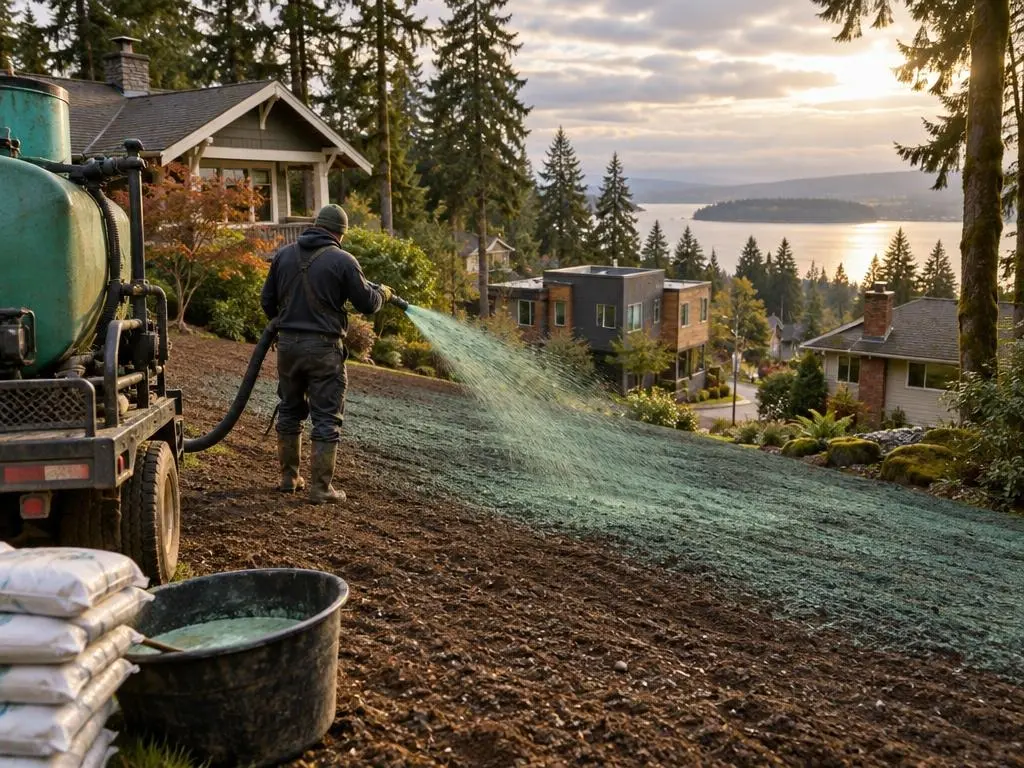
- Hydroseed slurry sprayed in overlapping passes for even coverage
- Watering instructions for the first three weeks and advice on the first mow
Why Homeowners Call Hydroseeding Seattle
Timing tied to the weather
We tell you up front whether your date will need summer watering or can ride the fall rains, and we adjust the plan to fit.
Soil checked before seed
We probe for shallow till, compaction and fill, and we recommend topsoil only where the soil is actually thin.
Grading to seeding in one sequence
Fine grading, topsoil, silt fence and hydroseed can all be handled by our crew, so bare ground does not wait between trades.
Mixes chosen per site
Shade under conifers, a sunny slope and a busy play area each get a different seed blend and mulch rate.
Common Questions
Can you grow grass in the fall in Seattle?
Yes, and early fall is usually the easier window here. The soil is still warm from summer, and the rains that return in October keep the mulch damp, so you water far less than you would after a spring seeding. Seed sown too late into November may sit until spring before it fills in.
Which grass types grow well in the Pacific Northwest?
Cool-season grasses. WSU Extension recommends mostly turf-type tall fescue and turf-type perennial ryegrass for western Washington lawns, with fine-leaved fescues as an option for light shade and low traffic. Mixes heavy in Kentucky bluegrass and warm-season grasses like bermuda and zoysia are poor choices here. We match the blend to how much sun the area gets and how it will be used.
Can I just throw grass seed down and expect it to grow?
Some of it will, but a lot gets eaten by birds, blown off or washed away, especially on any slope. Seed does best pressed into loosened soil and kept moist. Hydroseeding solves both by coating the seed in mulch and tackifier that hold water and stick to the ground.
When should you plant grass seed in Washington State?
West of the Cascades, late summer into early fall and mid-to-late spring are the usual windows. Around Seattle, fall seeding takes advantage of the returning rain, while spring seeding needs a reliable watering plan for the dry months that follow.
How much does hydroseeding cost in the Seattle area?
Published national guides differ by source: the low end is about $0.07 and the high end about $0.35 for each square foot of residential hydroseeding, and HomeGuide notes most companies have minimum job fees of $300 to $500 or more. Slopes, soil prep and access move the number. After we walk the yard, the written number we give you is the bill.
How soon can I walk on or mow a new hydroseed lawn?
Keep foot traffic off while it germinates and fills in. HomeGuide says that under favorable weather the first sprouts appear within 5 to 7 days, with the first mow due at 4 to 6 weeks. Mow high the first few times and only when the soil is firm.
Do you install silt fence and erosion control too?
Yes. We set silt fence, inlet protection, erosion control blankets and hydromulch or bonded fiber matrix on slopes. On a construction site, we can stage those first and seed once grading is done.
Neighborhoods, Suburbs and Valleys We Cover
Inside the city, we work from West Seattle to the north end, on hillside lots, planting strips and infill builds. East of Lake Washington, Bellevue, Kirkland, Redmond and Kenmore mix older neighborhoods with redevelopment, while Sammamish and Issaquah sit higher, on plateau and foothill ground near the Issaquah Alps where rainfall runs well above Seattle's. Bothell, Mill Creek, Lake Stevens and Marysville take us north into Snohomish County, with creek wetlands and delta soils to plan around. To the south, Renton, Kent, Auburn and Puyallup cover river valleys and the hills above them, and Federal Way, Covington, Maple Valley, Bonney Lake and Enumclaw bring lakes, new subdivisions and mudflow-plateau farmland. Out in the Snoqualmie Valley, Snoqualmie, North Bend and Duvall are the wettest towns we serve, where seeding dates matter most. Open any community below for its soils, slopes and timing.
- Hydroseeding in Seattle, WA
- Hydroseeding in Bellevue, WA
- Hydroseeding in Redmond, WA
- Hydroseeding in Sammamish, WA
- Hydroseeding in Issaquah, WA
- Hydroseeding in Kirkland, WA
- Hydroseeding in Bothell, WA
- Hydroseeding in Kenmore, WA
- Hydroseeding in Renton, WA
- Hydroseeding in Kent, WA
- Hydroseeding in Auburn, WA
- Hydroseeding in Maple Valley, WA
- Hydroseeding in Covington, WA
- Hydroseeding in Federal Way, WA
- Hydroseeding in Puyallup, WA
- Hydroseeding in Bonney Lake, WA
- Hydroseeding in Snoqualmie, WA
- Hydroseeding in North Bend, WA
- Hydroseeding in Duvall, WA
- Hydroseeding in Enumclaw, WA
- Hydroseeding in Mill Creek, WA
- Hydroseeding in Lake Stevens, WA
- Hydroseeding in Marysville, WA
Our Services
Six kinds of work, from a new hydroseed lawn to the dirt work and sediment control that make it last.
Hydroseed Lawn Installation
New lawns sprayed on prepared soil, with a seed mix picked for sun, shade and use.
Learn more →Contractor & Commercial Hydroseeding
Large-area seeding for builders, developers and property managers, staged around construction.
Learn more →Slope Stabilization & Erosion Control
Sprayed hydromulch, bonded fiber matrix and rolled blankets for Seattle cut slopes, swales and banks that won't stay put.
Learn more →Silt Fence & Inlet Protection
Perimeter silt fence, catch basin protection and sediment control for building and remodel sites.
Learn more →Grading, Topsoil & Dirt Work
Yard grading, topsoil spreading and soil prep so seed has the drainage and depth it needs.
Learn more →Lawn Renovation & Overseeding
Thin, mossy or patchy lawns brought back with aeration, overseeding and spot hydroseeding.
Learn more →Plan Your Seeding Before the Next Rain
Book a free site visit and get a written estimate for seed, soil and sediment work.